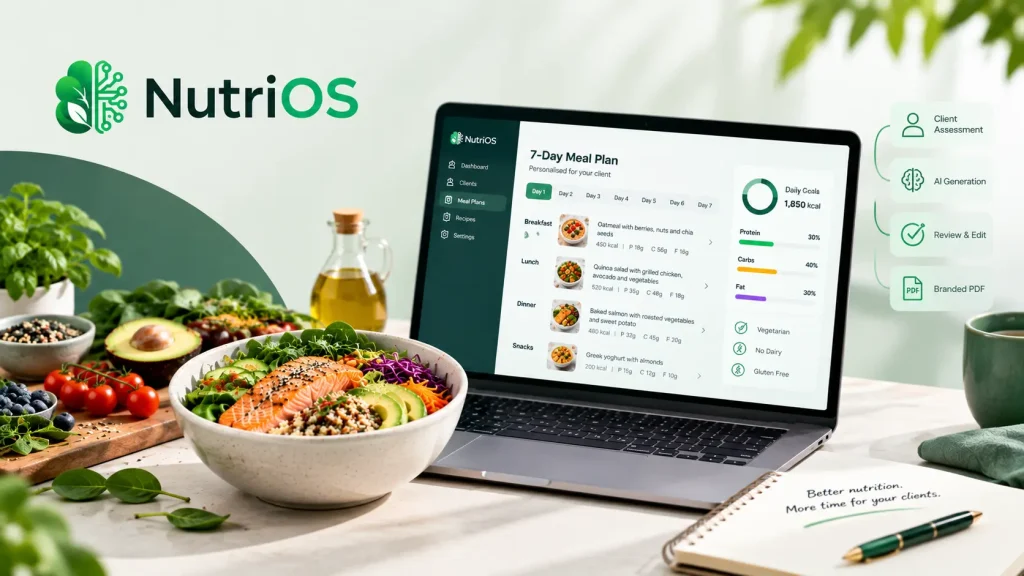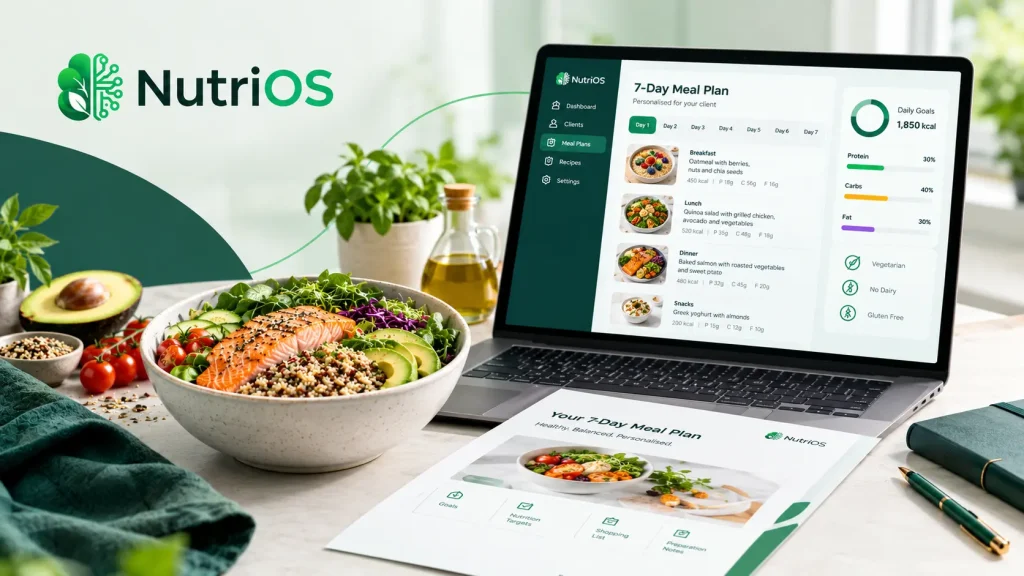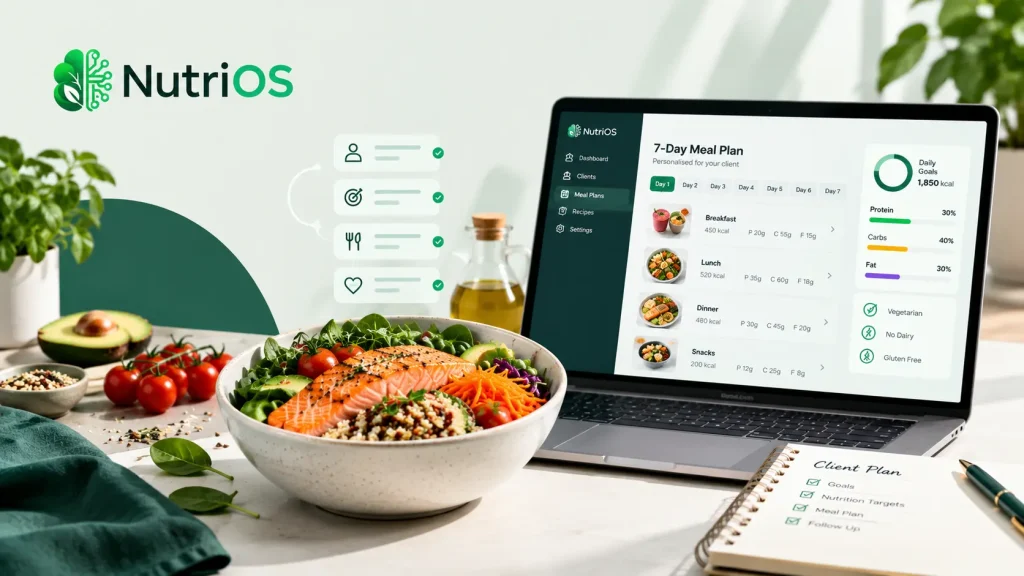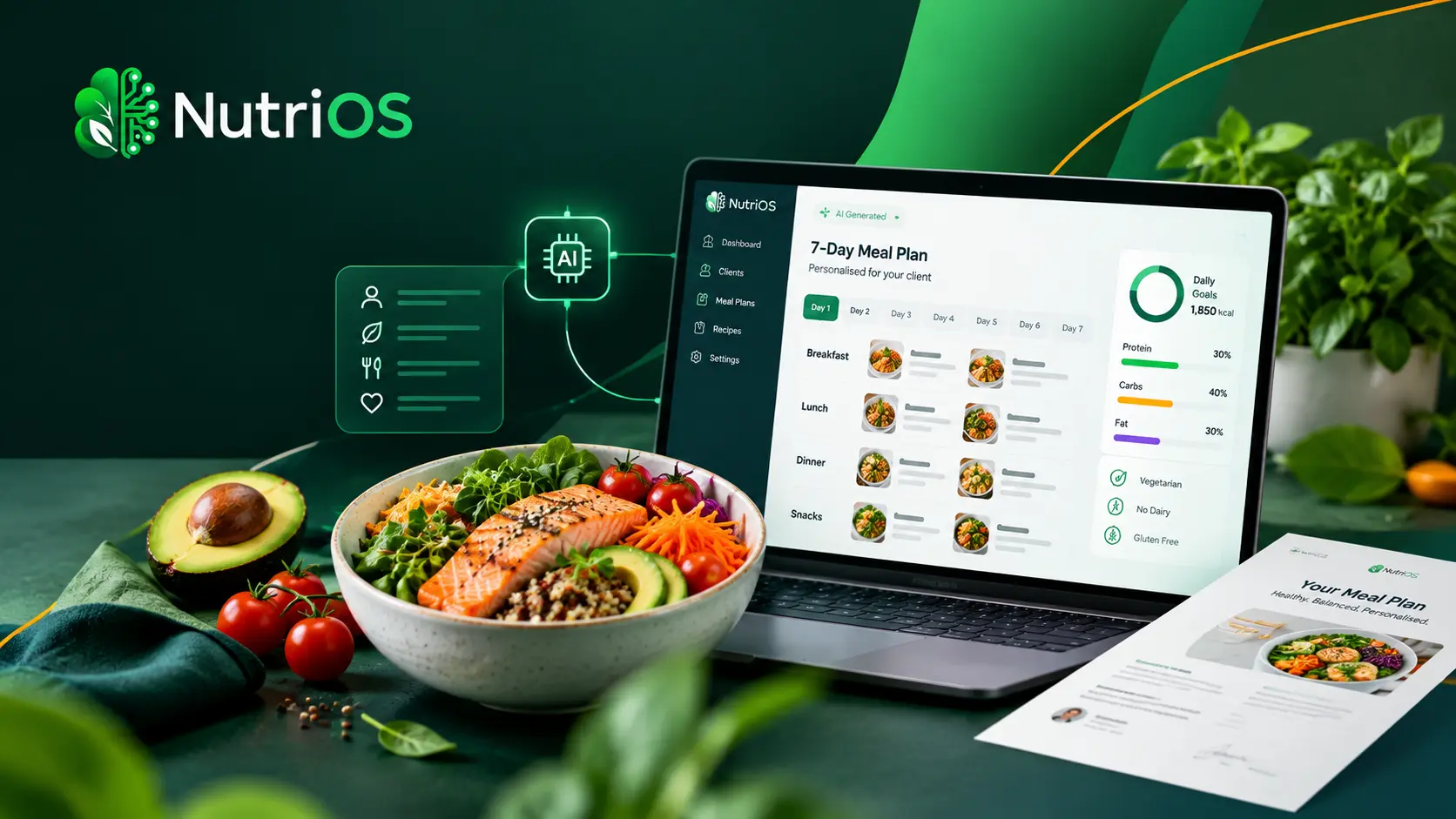
An AI meal plan generator is software that creates personalised meal plans from structured inputs like a client’s calorie targets, dietary preferences, allergies, and health goals. For nutrition professionals, it replaces hours of manual planning with a process that takes seconds, while keeping the clinician in control of every recommendation.
What is an AI meal plan generator?
An AI meal plan generator is a software tool that uses artificial intelligence to produce structured, personalised meal plans based on specific parameters you define. Rather than pulling from a static template library, it assembles meals dynamically, matching calorie targets, macronutrient ratios, dietary restrictions, allergens, and taste preferences into a coherent weekly plan.
The output typically includes:
- A day-by-day meal schedule covering breakfast, lunch, dinner, and snacks
- Calorie and macronutrient breakdown per meal and per day
- Recipes with preparation instructions
- An aggregated grocery list grouped by category
- Export options, usually as a PDF or shareable link
For a nutrition professional, the key distinction is this: the AI generates the draft. You review, adjust, and approve it before it reaches the client. The tool handles the repetitive, time-consuming assembly work. You provide the clinical judgement, personalisation, and professional oversight that no algorithm can replicate.
This is different from asking a general-purpose chatbot like ChatGPT to “make me a meal plan.” A dedicated AI meal plan generator operates within structured nutritional constraints, draws from verified food databases, and produces output that a qualified professional can review and stand behind.
NutriOS, for example, is built specifically for this workflow. You enter client details, the AI generates a 7 or 30-day plan, you review it, and send a branded PDF. The whole process takes under two minutes. See how it works.
Why does AI meal planning matter for nutrition professionals?
Meal planning is one of the most time-intensive parts of running a nutrition practice. A 2024 Adecco Group survey of 35,000 workers across 27 economies found that professionals using AI tools saved an average of one hour per day, with a fifth reporting savings of up to two hours. For nutrition practitioners, that recovered time translates directly into client capacity, clinical focus, and business sustainability.
The problem is straightforward. Building a single, thorough 7-day meal plan for a client with specific health goals, dietary restrictions, and food preferences typically takes 30 to 60 minutes when done properly. That includes calculating targets, selecting appropriate foods, ensuring nutritional adequacy, formatting the plan, and creating a presentable deliverable.
For a practitioner managing 20 active clients, that is 10 to 20 hours per month spent on planning logistics alone, time that could go toward consultations, assessments, follow-ups, and clinical reasoning.
An AI meal plan generator compresses the planning phase from 30 to 60 minutes to roughly 30 seconds of generation time plus 5 to 10 minutes of professional review. The result is not a finished plan sent blindly to a client. It is a well-structured draft that a qualified nutritionist or dietitian refines, adapts, and takes responsibility for.
This shift matters for three reasons:
Time recovery. Less time building plans means more time with clients, more capacity for new consultations, and less weekend administrative work.
Consistency. AI-generated plans maintain nutritional balance across the full week, not just per meal. Macronutrient distribution, calorie targets, and dietary pattern adherence are checked algorithmically, reducing the risk of oversight that comes with manual planning fatigue.
Professional presentation. Plans exported as branded PDFs with your logo, colour scheme, and practice details create a client experience that reflects the quality of your work, not a spreadsheet thrown together between appointments. NutriOS offers 10+ professional PDF templates so every plan looks polished and on-brand.
How does an AI meal plan generator work?
Behind the scenes, an AI meal plan generator solves a complex optimisation problem. It must balance multiple competing constraints simultaneously, something that is computationally straightforward for a machine but mentally exhausting for a human doing it sequentially.
The process typically follows these steps:
1. Input collection
You provide the client’s parameters: daily calorie target, macronutrient split (protein, carbohydrates, fat), dietary pattern (Mediterranean, vegetarian, keto, low-FODMAP, and others), allergens and intolerances, foods to exclude, number of meals per day, cooking time preferences, and any relevant health conditions.
2. Nutritional calculation
Using validated formulas such as Mifflin-St Jeor for basal metabolic rate, the system calculates energy needs and applies the appropriate surplus or deficit based on the client’s goal. Macronutrient targets are derived from these calculations.
3. Recipe matching and meal assembly
The generator selects meals from a recipe database that collectively meet the day’s nutritional targets. This is where quality varies significantly between tools. A well-built system checks that the selected meals actually sum to the stated calorie and macro targets, rather than producing plausible-sounding numbers.
4. Weekly optimisation
The system distributes meals across the week for variety, practical sequencing (quicker meals on busy days), ingredient reuse (reducing waste and cost), and overall nutritional adequacy across the full seven-day period.
5. Validation and output
Each day’s plan is checked against the client’s profile. If a meal drifts from the target, an allergen slips through, calories run too high, or a macro balance is off, the system rejects and replaces it. The final output is a structured plan with recipes, nutrition data, and a consolidated grocery list.
6. Professional review
This step is non-negotiable for clinical practice. The nutrition professional reviews the generated draft, makes adjustments based on clinical knowledge the AI cannot access (medication interactions, recent lab results, psychological factors, cultural considerations, and the client’s real-world context), and approves the final version.
In practice, this means the AI does the heavy lifting and you do the thinking. That division is exactly how NutriOS is designed to work.
AI meal plan generator vs. ChatGPT: what is the difference?
This is one of the most common questions in the space, and the answer matters for professionals considering AI tools.
A general-purpose chatbot like ChatGPT can produce a meal plan when prompted. Research published in the Journal of Nutrition in 2026 found that ChatGPT-generated meal plans achieved 55 to 83 percent adherence to official nutrition guidelines, compared with 50 to 100 percent for human dietitians. The results were closer than expected, but the failure modes are clinically significant.
Peer-reviewed studies have consistently identified the same limitations in chatbot-generated meal plans:
Calorie inconsistency. A 2026 benchmark across ChatGPT, Claude, and Gemini found that while ChatGPT and Claude hit calorie targets within 5 percent in controlled tests, Gemini missed by up to 29 percent. A 2025 Polish-language study found all three major models undershot energy targets by 284 to 546 kcal at 2,000-calorie targets.
Micronutrient gaps. Research from 2024 found that AI-generated plans frequently fell below recommended levels for calcium, potassium, and vitamin B1. Vitamin D was insufficient in every plan tested across multiple studies, including those created by human dietitians. Vegan plans were particularly weak on B12. Five out of six completed vegan plans in the 2026 Fuel Nutrition benchmark provided no vitamin B12 at all.
Allergen risk. While major allergens are generally caught, the language around cross-contact and processing warnings is inconsistent. A 2026 study found that one in nine tested plans skipped manufacturing cross-contact safeguards.
No clinical context. ChatGPT cannot account for a client’s medication schedule, recent blood work, psychological relationship with food, cultural food practices, or the dozen other factors that turn a generic plan into effective clinical guidance.
No memory between sessions. Without a structured tool, the practitioner must re-enter all client parameters for every plan. There is no client profile, no saved preferences, no plan history.
A dedicated AI meal plan generator addresses several of these issues through structured constraints, verified food databases, and persistent client profiles. It is not a replacement for professional judgement, but it is a substantially more reliable starting point than a chatbot prompt.
What to look for when choosing an AI meal plan generator
Not all tools marketed as “AI meal planners” are built for the same purpose. The current market splits broadly into two categories: consumer tools designed for individuals planning their own meals, and professional tools designed for practitioners managing multiple clients.
When evaluating options for your practice, prioritise these criteria:
Nutritional accuracy
The tool should pull nutrition data from verified food databases such as USDA FoodData Central, EFSA databases, or national equivalents rather than generating calorie and macro estimates on the fly. Ask whether nutrition values are computed from per-100g ingredient data or estimated by a language model. The difference matters clinically.
Professional workflow
Look for tools that support a generate, review, edit, approve, and deliver workflow. The practitioner must remain in the loop. A tool that generates plans and sends them directly to clients without professional review is not designed for clinical practice.
Client management
The ability to store client profiles, save preferences, track plan history, and manage multiple clients from a single dashboard is essential for any practice with more than a handful of active clients.
Branded output
Plans delivered to clients should carry your practice branding, including logo, colour scheme, and contact details. This communicates professionalism, builds trust, and differentiates your service from generic app-generated plans.
European relevance
If you practise in Europe, the tool should support metric units by default, include European seasonal produce, and ideally use food databases relevant to your region. Plans built exclusively around American ingredients and USDA data may not reflect what your clients actually buy at their local supermarket.
GDPR compliance
Client data, including dietary restrictions, health conditions, weight, and goals, is sensitive personal data under the General Data Protection Regulation. Any tool you use to manage this data should be GDPR-compliant, with data stored within the EU or under appropriate transfer safeguards. NutriOS stores all client data on EU-based servers. Read the full privacy policy.
Dietary pattern depth
A professional tool should support clinical dietary patterns like low-FODMAP, renal-friendly, diabetic-appropriate, and anti-inflammatory, not just lifestyle diets like keto or vegan. The depth of dietary pattern support reflects how seriously the tool takes nutritional science.
AI meal planning for European nutrition professionals: what is different
The European nutrition landscape has distinct characteristics that generic AI tools often overlook.
Food databases. Most AI meal planners are built on USDA FoodData Central, an American database. While nutrition science is universal, food composition varies by region. A tomato grown in southern Spain has a different nutritional profile than one from a hothouse in northern Europe. European practitioners benefit from tools that incorporate regional food data or at minimum use a database with broad international coverage.
Seasonal produce. European dietary guidance increasingly emphasises seasonal, locally available produce. An AI tool that suggests strawberries in January for a UK client or asparagus in October for a German client is not reflecting European eating patterns. Seasonal awareness improves client adherence, reduces cost, and aligns with sustainability goals.
Metric units. This seems minor but matters in practice. A tool that outputs portions in cups and ounces requires conversion for European clients accustomed to grams and millilitres. Professional output should default to metric.
GDPR and client data. The General Data Protection Regulation classifies dietary restrictions, health conditions, weight, and nutritional goals as personal data. Any AI tool that stores or processes this information must comply with GDPR requirements. This includes data storage location, consent mechanisms, data portability, and the right to deletion.
European dietary guidelines. European nutrition guidance from EFSA, national health authorities, and professional bodies does not always align with American dietary recommendations. Protein recommendations, fat quality guidelines, and specific nutrient reference values can differ. A tool aligned with European standards produces more clinically relevant output for European practitioners.
Common mistakes when using AI meal plan generators
Even with the right tool, certain practices reduce the quality of output:
Vague client profiles. The AI is only as good as the inputs it receives. Entering “lose weight” without specifying a calorie target, protein goal, or timeline produces generic output. The more precise your inputs, the more useful the draft.
Skipping professional review. Generating a plan and sending it directly to a client without reviewing it is clinically irresponsible. AI handles the structural work. You handle the judgement. Every plan should pass through your professional assessment before delivery.
Over-relying on calorie accuracy. Research consistently shows that AI calorie estimates can deviate by 10 to 20 percent from actual values, particularly for composite recipes and oils. Verify important items against your own knowledge and a trusted database before relying on the numbers.
Ignoring client context. An AI cannot account for a client’s stress levels, sleep quality, medication timing, recent lab results, or relationship with food. These factors directly affect nutritional needs and must be incorporated through professional oversight.
Using consumer tools for clinical practice. Consumer meal planners are built for individuals managing their own eating. They lack client management, professional branding, clinical dietary patterns, and the workflow structure that professional practice requires. Using a consumer tool and calling it professional practice creates unnecessary risk.
Professional meal plans in 30 seconds, not 30 minutes.
Create your account today. Your first professional meal plan is 30 seconds away.
The role of AI in professional nutrition practice
The evidence is clear on one point: AI meal plan generators are tools that augment professional practice, not replace it.
A 2026 systematic review published in Dietetics concluded that while AI chatbots show promise for personalised meal planning, “the expertise and refined judgement of dietetic professionals remain indispensable, particularly when addressing the complexity of individualised dietary needs.” The review identified cultural food preferences, religious dietary restrictions, individual medical histories, and clinical conditions as areas where current AI models are not yet equipped to provide safe, standalone guidance.
This aligns with the position of major professional organisations. The Academy of Nutrition and Dietetics and the American Heart Association both caution that AI tools are supplements to professional care, not replacements.
For nutrition professionals, the practical framework is:
AI handles: Recipe selection, nutritional calculation, macro balancing, grocery list generation, formatting, and repetitive planning logistics.
You handle: Clinical assessment, medical nutrition therapy, medication-nutrient interactions, behavioural coaching, cultural sensitivity, psychological context, professional accountability, and the final clinical decision.
The result is a practice that runs more efficiently without compromising the quality of care. Clients receive well-structured, professionally reviewed meal plans faster. Practitioners reclaim hours per month that can be redirected toward clinical work, professional development, or simply sustainable working hours.
A practical example: AI meal planning in action
Consider a realistic scenario. A nutritionist in the Netherlands is working with a 42-year-old client who has type 2 diabetes, a preference for Mediterranean-style cooking, a lactose intolerance, and a goal of losing 8 kilograms over three months.
Without AI: The nutritionist spends 45 minutes calculating appropriate calorie and macro targets, researching suitable recipes that exclude lactose, ensuring carbohydrate distribution supports blood sugar management, assembling a 7-day plan, formatting it, and creating a presentable deliverable.
With AI: The nutritionist enters the client’s profile (1,650 kcal target, 30 percent protein, 40 percent carbohydrates, 30 percent fat, Mediterranean pattern, lactose-free, 3 meals plus 2 snacks) into the AI meal plan generator. In approximately 30 seconds, the system produces a structured 7-day plan with recipes, nutrition breakdowns, and a grocery list.
The nutritionist then spends 8 to 10 minutes reviewing the output: checking carbohydrate distribution across meals for blood glucose management, verifying portion sizes are appropriate, swapping one recipe that uses an ingredient the client has previously rejected, adding a note about meal timing relative to the client’s medication schedule, and approving the final plan.
The finished plan is exported as a branded PDF with the nutritionist’s practice logo and sent to the client. Total time: approximately 12 minutes, compared with 45 minutes of manual planning.
That saved half-hour is not about doing less. It is about spending more of your professional time on the things that actually require your expertise.
Frequently asked questions
What is an AI meal plan generator?
An AI meal plan generator is software that uses artificial intelligence to create personalised meal plans from structured inputs, including calorie targets, macronutrient ratios, dietary preferences, allergens, and health goals. For nutrition professionals, the workflow involves generating a draft, reviewing it against clinical requirements, and approving it before sending to a client.
How accurate are AI-generated meal plans?
Accuracy varies by tool and depends on the quality of the underlying food database. Tools that compute nutrition values from verified per-100g ingredient data are generally reliable for macronutrient targets, with calorie accuracy within 5 percent for well-built tools. Micronutrient accuracy is less consistent, and clinical verification is always recommended.
Can AI replace dietitians for meal planning?
No. AI meal plan generators handle the structural and computational aspects of meal planning, including recipe selection, nutritional calculation, formatting, and grocery list generation. They cannot assess clinical conditions, account for medications, understand a client’s psychological relationship with food, or make clinical decisions. Professional oversight remains essential.
What is the difference between an AI meal planner and ChatGPT?
A dedicated AI meal planner operates within structured nutritional constraints, uses verified food databases, stores client profiles, and produces formatted output designed for professional use. ChatGPT is a general-purpose chatbot that lacks persistent client data, structured validation, professional workflow, and clinical dietary pattern support.
Is AI meal planning GDPR-compliant in Europe?
It depends on the tool. Any AI meal planning software that stores or processes client health data must comply with GDPR. This requires EU-based or appropriately safeguarded data storage, consent mechanisms, data portability, and the right to deletion. Always verify a tool’s data handling practices before using it with client information.
How long does it take to generate an AI meal plan?
Most professional AI meal planners generate a complete 7-day plan in 20 to 60 seconds. Professional review and adjustment typically adds 5 to 10 minutes. The total workflow, from entering client details to exporting a finished, branded PDF, generally takes under 15 minutes, compared with 30 to 60 minutes for manual planning.
What should nutrition professionals look for in an AI meal plan generator?
Prioritise nutritional accuracy with verified food databases, professional workflow with generate-review-approve capability, client management, branded PDF output, European relevance including metric units and seasonal produce, GDPR compliance, and clinical dietary pattern support.