A 7-day meal plan is a structured weekly eating framework personalised to one client’s goals, dietary needs and lifestyle. For nutrition professionals across Europe, it is the most common deliverable — and the one that consumes the most time to create well.
This guide covers the full professional workflow: from initial client assessment through to a delivered, branded 7-day plan. It addresses European dietary considerations, practical time-saving strategies, and how AI-assisted tools are changing the way nutritionists, dietitians and health coaches build weekly plans without losing clinical control.
What Is a 7-Day Meal Plan?
A 7-day meal plan is a written eating schedule that maps out breakfast, lunch, dinner and snacks across one full week. Unlike a generic recipe collection, a professional 7-day meal plan is built around a specific client’s calorie targets, macronutrient requirements, dietary restrictions, food preferences and health goals.
The plan typically includes:
- Daily meal structure — which foods to eat at each meal occasion
- Portion sizes — specific quantities in grams, cups or standard measures
- Macronutrient breakdown — protein, carbohydrate and fat per meal and per day
- Calorie totals — aligned to the client’s energy target
- Grocery list — all ingredients organised by store section
- Preparation notes — batch cooking tips, storage guidance and reheating instructions
For the client, the plan removes daily decision fatigue. For the nutrition professional, the plan is the tangible output that demonstrates expertise, builds trust and drives results.
Why 7-Day Meal Plans Matter for Your Practice
Client adherence
Research consistently shows that structured eating plans improve dietary adherence compared to verbal advice alone. When clients know exactly what to buy and cook each day, they make fewer impulsive food choices and stay closer to their targets.
Professional credibility
A well-designed, branded 7-day meal plan signals competence. Clients judge the quality of your service partly by the quality of the deliverables you hand them. A clean, personalised PDF with their name, your logo and accurate nutritional data reinforces the value of your expertise.
Practice efficiency
The challenge is time. Most nutrition professionals spend 45 to 90 minutes building a single 7-day plan manually — calculating macros, selecting recipes, adjusting portions, checking allergens and formatting the document. At 10 active clients, that becomes 8 to 15 hours per week spent on planning rather than client care.
Understanding this workflow bottleneck is the first step toward solving it.
How to Create a 7-Day Meal Plan: Step-by-Step
Step 1: Complete the client assessment
Every effective 7-day plan starts with thorough intake. This covers:
- Health goals — weight loss, muscle gain, sports performance, clinical management, general wellness
- Current metrics — age, sex, height, weight, body composition if available
- Activity level — training frequency, type, intensity, daily movement patterns
- Dietary restrictions — allergies, intolerances, religious requirements, ethical preferences
- Lifestyle factors — cooking skill, time available, budget, family meals
- Food preferences — likes, dislikes, cultural foods, meal timing preferences
Use a standardised intake form for consistency. This ensures you gather the same information from every client and provides a professional first impression.
Step 2: Calculate energy and macronutrient targets
With assessment data in hand, calculate the client’s caloric needs and macro targets.
Basal Metabolic Rate (Mifflin-St Jeor equation):
- Men: (10 × weight in kg) + (6.25 × height in cm) − (5 × age) + 5
- Women: (10 × weight in kg) + (6.25 × height in cm) − (5 × age) − 161
Apply an activity multiplier:
| Activity Level | Multiplier |
|---|---|
| Sedentary | 1.2 |
| Lightly active | 1.375 |
| Moderately active | 1.55 |
| Very active | 1.725 |
| Extremely active | 1.9 |
Adjust for the goal:
- Weight loss: subtract 300–500 kcal
- Muscle gain: add 200–400 kcal
- Maintenance: use TDEE as calculated
Macro distribution for active individuals:
| Macro | Range | Notes |
|---|---|---|
| Protein | 1.6–2.2 g per kg body weight | Higher for calorie-restricted clients |
| Carbohydrates | 40–55% of total calories | Higher for endurance athletes |
| Fat | 20–35% of total calories | Minimum 0.5 g per kg |
European dietary reference values vary by country. The UK uses the Eatwell Guide, Nordic countries follow the Nordic Nutrition Recommendations, and Mediterranean countries reference their own national guidelines. Where your client is based matters for micronutrient targets and food group recommendations.
Step 3: Structure the weekly framework
Design the week’s meal structure before selecting individual recipes. Decide:
- Number of meals per day — typically 3 main meals plus 1–2 snacks
- Meal timing — aligned to the client’s schedule, training times and preferences
- Leftover strategy — which dinners double as next-day lunches
- Batch cooking opportunities — proteins and grains that can be prepared once and used across multiple meals
- Flexibility slots — 1–2 evenings left open for social eating or spontaneous choices
The most effective 7-day plans repeat 20–30% of meals across weeks. Familiar food is easier to shop for, simpler to prepare and more likely to be followed consistently.
Step 4: Select meals and build the grid
Choose specific meals for each slot, ensuring:
- Every meal contributes to the daily macro and calorie target
- Variety across the week for micronutrient coverage
- Recipes match the client’s cooking skill and available time
- Allergies and restrictions are respected at every meal
- Ingredients are available in the client’s local market
European seasonal consideration: Build meals around what is locally available and in season. In Northern Europe, autumn and winter favour root vegetables, brassicas, oily fish and preserved foods. Mediterranean regions offer abundant fresh produce, legumes and olive oil year-round. Seasonal planning improves flavour, reduces cost and supports sustainable eating — all factors that improve client adherence.
Step 5: Extract the grocery list and prep notes
Pull every ingredient from the planned meals and organise by store section: produce, proteins, dairy, pantry staples, frozen. Add quantities so the client shops once and shops accurately.
Include batch cooking notes: roast a tray of chicken on Sunday for Monday through Wednesday lunches. Cook a pot of grains to portion across the week. Prepare overnight oats the evening before.
Step 6: Review, personalise and deliver
Before sending, review the complete plan against the client’s targets. Check that daily calories are within range, macros balance across the week (not just per day), and no restricted foods have slipped in.
Deliver the plan as a professional, branded PDF. Include your practice name, logo and contact details. A clean, well-formatted document reinforces the value of your service and gives the client something they can print, save to their phone or reference while shopping.
What a Professional 7-Day Meal Plan Should Include
| Component | Why It Matters |
|---|---|
| 7-day meal grid | Clear daily structure the client can follow |
| Calorie and macro totals | Transparent targets for accountability |
| Exact portion sizes | Removes guesswork and improves accuracy |
| Grocery list | One trip, one list, no waste |
| Prep notes | Batch cooking and storage guidance |
| Dietary restriction notes | Condition-specific information where relevant |
| Branded presentation | Reinforces professional credibility |
Handling Dietary Restrictions in 7-Day Plans
Common restrictions and planning considerations
Vegetarian and vegan: Ensure complete protein combinations (legumes with grains), B12 awareness, iron paired with vitamin C for absorption, calcium from fortified alternatives.
Gluten-free: Substitute with rice, quinoa, potatoes, corn-based products. Check labels on sauces and processed foods for hidden gluten.
Dairy-free: Source calcium from fortified plant milks, leafy greens, tinned fish with bones where appropriate.
Diabetic plans: Consistent carbohydrate distribution across meals (typically 45–60 g per main meal for adults), fibre emphasis, consistent meal timing, coordination with medication where applicable.
Religious and cultural requirements: Halal, kosher, fasting periods (Ramadan, Lent) — source compliant ingredients and structure meals around observance schedules.
Multiple restrictions: When a client has two or more restrictions (e.g., vegan + gluten-free), the planning complexity increases significantly. This is where template libraries and AI-assisted generation save the most time.
Scope of practice reminder
In many European countries, “nutritionist” is not a legally protected title, while “dietitian” is regulated. General wellness and fitness-focused meal plans fall within the scope of most nutrition professionals. Clinical meal plans for medical conditions — diabetes management, renal disease, eating disorders — should be created by or in collaboration with a registered dietitian.
Common Mistakes in 7-Day Meal Planning
Planning too many unique meals. Cooking 21 different recipes per week is unrealistic for most clients. Build around 12–15 core meals, with repetition where appropriate.
Professional meal plans in 30 seconds, not 30 minutes.
Create your account today. Your first professional meal plan is 30 seconds away.
Ignoring the client’s actual kitchen. A plan that assumes daily cooking from scratch fails for a client with 20 minutes of evening time. Know their equipment, their schedule and their energy levels.
Over-restricting without substitution. Removing foods without providing alternatives creates frustration and abandonment. Every restriction should come with satisfying swaps.
Neglecting the grocery list. A meal plan without a matched shopping list is a suggestion, not a plan. The list is what turns intention into action.
Forgetting social context. Clients eat with partners, families, colleagues and friends. A plan that ignores social eating creates conflict and guilt.
Using inaccurate food databases. User-generated nutrition data (like generic entries in free apps) can be significantly off. Use verified databases — USDA FoodData Central, UK McCance and Widdowson’s, or national equivalents — for clinical accuracy.
7-Day Meal Planning for European Nutrition Professionals
European dietary landscape
European eating patterns vary significantly by region. A 7-day plan for a client in the Netherlands differs from one for a client in Spain, not just in recipes but in meal structure, staple foods, cooking methods and cultural expectations around food.
UK and Ireland: Strong tradition of structured meals, high tea/coffee consumption, growing interest in plant-based eating. The Eatwell Guide provides the reference framework.
Northern Europe (Scandinavia, Netherlands, Germany): Emphasis on whole grains, rye bread, oily fish, fermented foods (yoghurt, kefir, sauerkraut), root vegetables. The Nordic Nutrition Recommendations guide public health nutrition.
Mediterranean (Spain, Italy, Greece, Southern France): Olive oil as primary fat, high vegetable and legume intake, moderate fish and wine, smaller portions of red meat. The Mediterranean diet pattern is well-evidenced for cardiovascular and metabolic health.
Central and Eastern Europe: More varied — traditional diets often feature soups, fermented vegetables, dairy, pork and seasonal produce. Nutritional guidance varies by country.
Seasonal ingredient planning
Building 7-day plans around seasonal European produce improves flavour, reduces cost and supports sustainability. It also gives your plans a freshness that generic template plans lack.
- Spring: Asparagus, peas, broad beans, new potatoes, spring greens, rhubarb, strawberries
- Summer: Tomatoes, courgettes, peppers, aubergines, stone fruits, berries, fresh herbs, salad leaves
- Autumn: Root vegetables, squash, apples, pears, mushrooms, game, oily fish, preserved summer produce
- Winter: Brassicas, citrus, stored root vegetables, pulses, dried fruits, warming spices, preserved foods
GDPR and client data
If you store client dietary information, health data or meal plans digitally — and most professionals do — you are handling personal data that falls under the EU General Data Protection Regulation.
Key considerations:
- Store client data in GDPR-compliant systems
- Obtain clear consent for data collection and processing
- Allow clients to request deletion of their data
- Ensure any software you use handles data within the EU or with adequate safeguards
- Document your data processing activities
This is not optional. It is a legal requirement for nutrition professionals operating in or serving clients within the EU.
Using AI to Create 7-Day Meal Plans Faster
The traditional workflow — manual calculation, recipe hunting, formatting, proofreading — takes 45 to 90 minutes per plan. AI-assisted tools reduce this to minutes while keeping you in clinical control.
What AI handles well
- Macro and calorie calculation — deterministic math, no professional judgement required
- Recipe selection from verified databases — matching ingredients to dietary restrictions and macro targets
- Portion scaling — adjusting quantities to hit specific nutritional targets
- Grocery list generation — pulling ingredients from planned meals automatically
- Professional formatting — branded PDF output in seconds
What AI should not replace
- Client assessment interpretation — understanding context, red flags and non-verbal cues
- Clinical judgement — deciding whether a plan is appropriate for a client’s medical situation
- Relationship building — the review conversation, the follow-up check-in, the adjustment based on feedback
- Scope of practice decisions — knowing when to refer, when to collaborate and when to hold your professional boundary
The most effective approach is AI-assisted, not AI-automated. The technology generates a strong draft in seconds. You review, adjust and personalise it with your expertise. The result is a plan that is both faster to produce and higher quality than what either you or the software would create alone.
Professional meal plans in 30 seconds, not 30 minutes.
Create your account today. Your first professional meal plan is 30 seconds away.
The NutriOS workflow
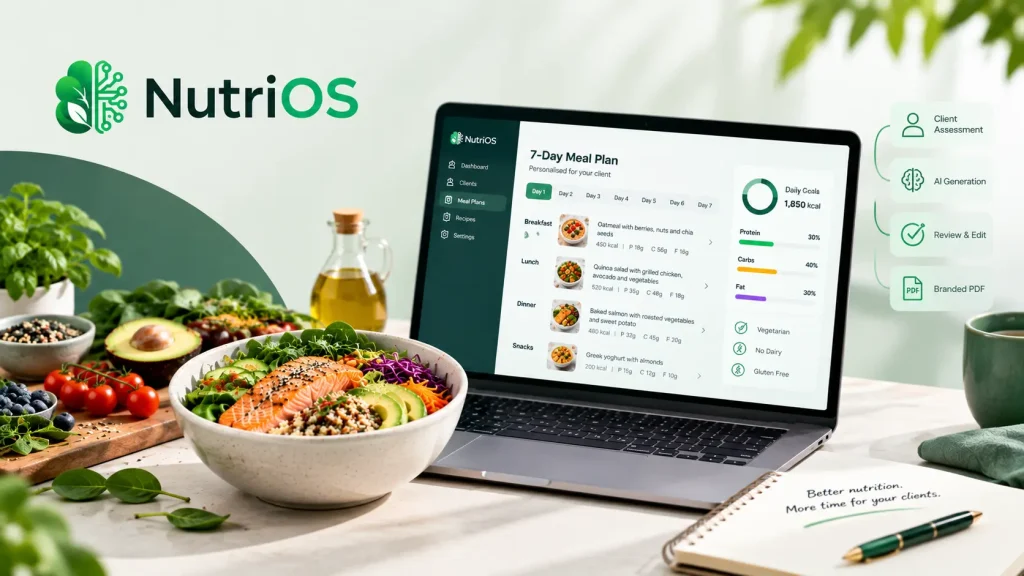
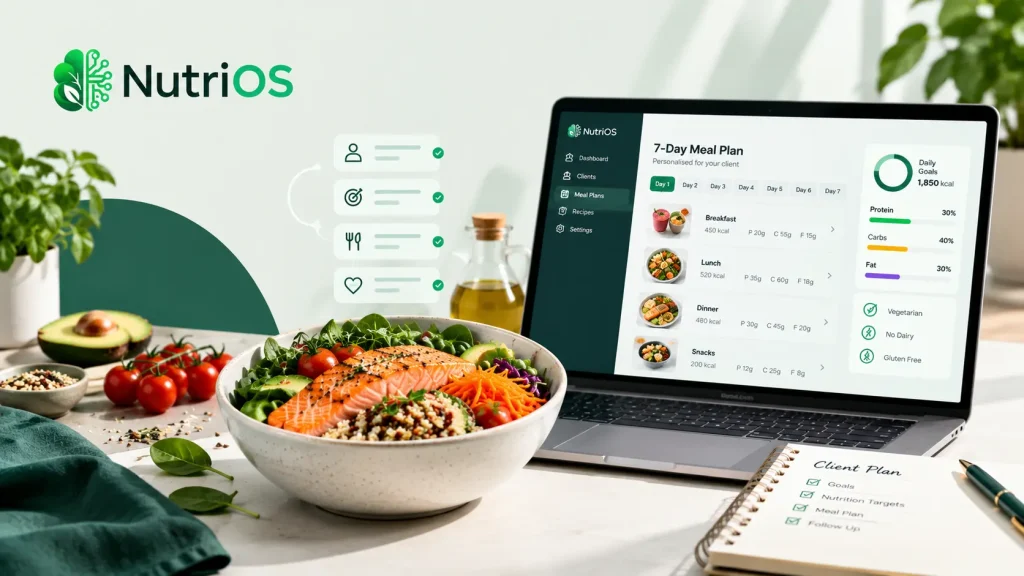
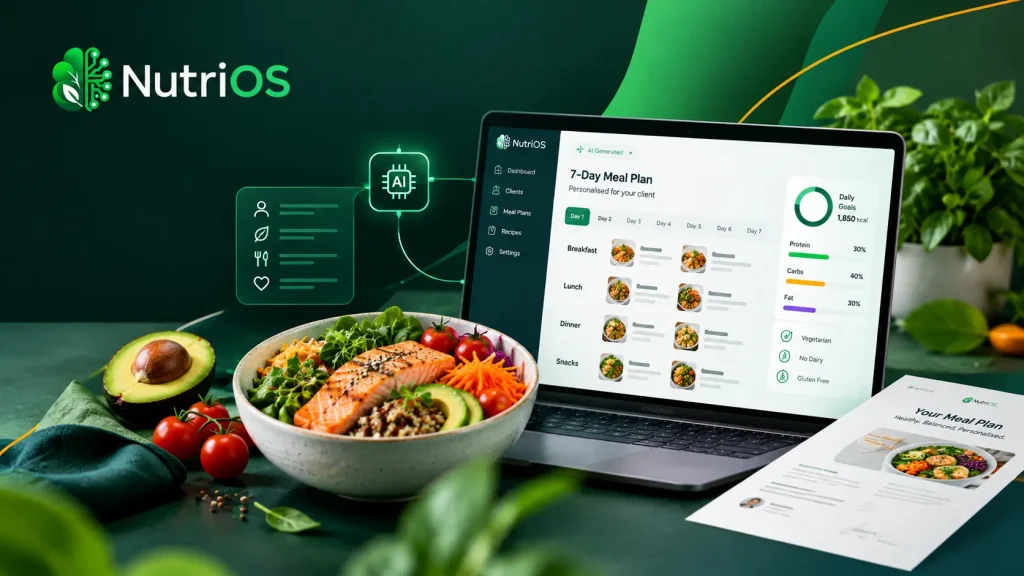
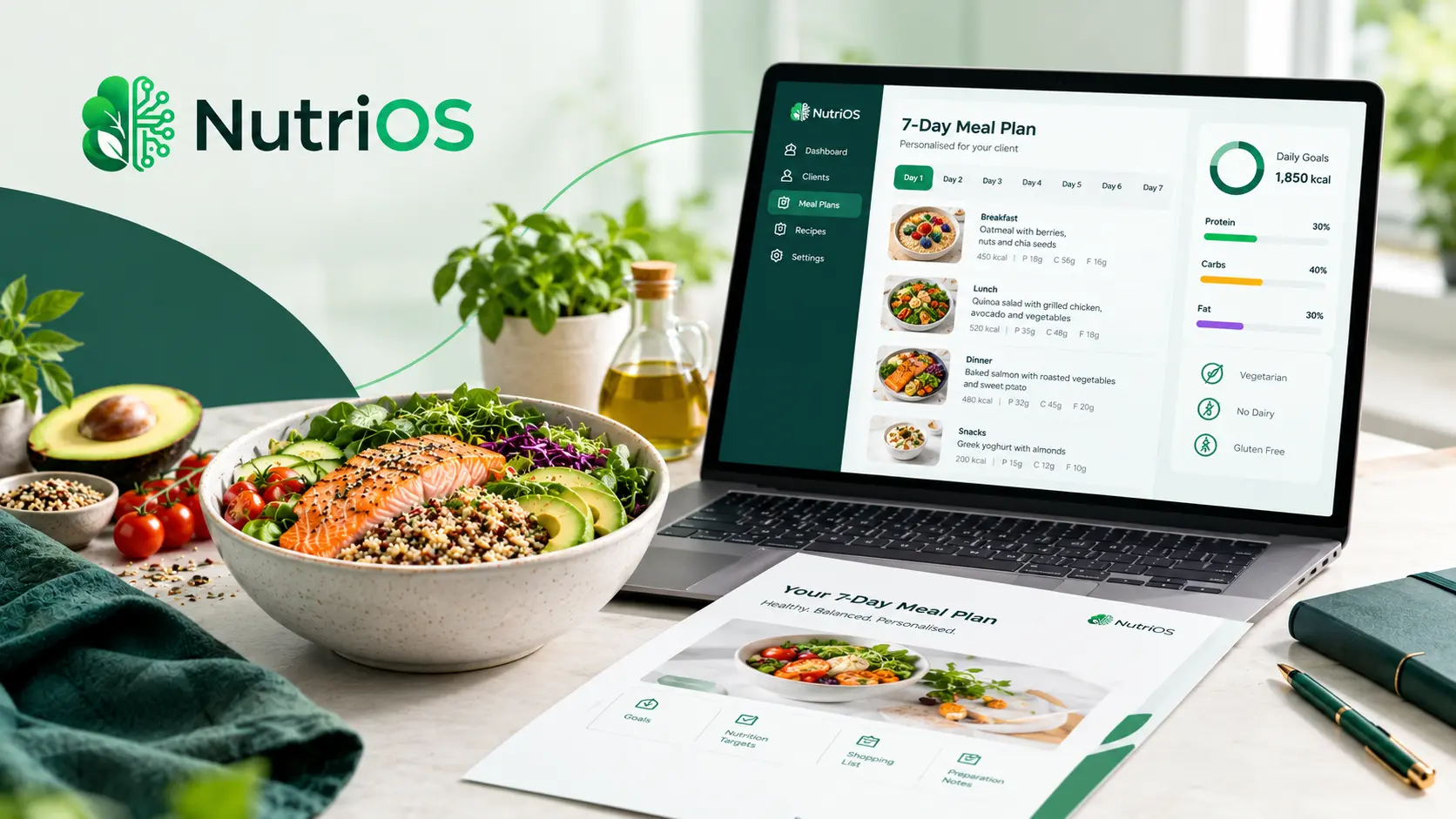
NutriOS follows this model: enter client details, let AI generate a personalised 7-day plan with calorie and macro breakdowns, review and edit the output, then export as a professional branded PDF. The nutritionist stays in control at every step. The AI handles the repetitive calculation and formatting. The client gets a plan that is accurate, personalised and professionally presented.
Practical Example: A 7-Day Plan Framework
This is a structural example, not a prescribed menu. Use it as a template to build around your client’s specific needs.
| Day | Breakfast | Lunch | Dinner | Snack |
|---|---|---|---|---|
| Monday | Oatmeal with berries and nuts | Leftover dinner | Baked salmon with roasted vegetables and rice | Greek yoghurt |
| Tuesday | Scrambled eggs with wholemeal toast | Chicken and grain salad | Lentil and vegetable curry with brown rice | Apple and almond butter |
| Wednesday | Yoghurt with granola and fruit | Tuna wrap with salad | Stir-fried chicken with noodles and vegetables | Hummus with crudités |
| Thursday | Smoothie with fruit, greens and protein | Leftover curry | Baked white fish with sweet potato and greens | Mixed nuts |
| Friday | Overnight oats with seeds | Quinoa bowl with roasted vegetables | Lean beef mince pasta with side salad | Cheese and crackers |
| Saturday | Full breakfast (eggs, beans, toast, tomatoes) | Leftover pasta or soup | Homemade pizza with vegetable toppings | Fruit salad |
| Sunday | Porridge with banana and cinnamon | Roast dinner | Roast chicken with seasonal vegetables and potatoes | Dark chocolate and berries |
Key patterns in this framework:
- Leftover lunches reduce cooking time by 50%
- Sunday roast provides leftovers for Monday lunch
- One batch of grains serves multiple meals
- Protein variety across the week (fish, chicken, beef, legumes, eggs)
- Vegetables at every meal
- One flexible evening (Saturday) for social eating
- Snacks are simple, portable and protein-inclusive
Frequently Asked Questions
How long does it take to create a 7-day meal plan?
Manually, most nutrition professionals spend 45 to 90 minutes per plan. With meal planning software, this reduces to 5 to 15 minutes. Experienced practitioners with established template libraries can complete a plan in under 10 minutes.
What should a professional 7-day meal plan include?
A complete plan includes the 7-day meal grid, calorie and macronutrient targets per day, exact portion sizes, a consolidated grocery list organised by store section, preparation and batch cooking notes, and condition-specific guidance where relevant.
How often should I update a client’s meal plan?
Review and adjust every 2 to 4 weeks. Check progress against goals, gather feedback on which meals worked and which did not, and make targeted adjustments. Plans that are never updated lose relevance and client engagement drops.
Can I use the same 7-day plan for multiple clients?
Use templates as a starting point, but always personalise for each client. Two clients with the same calorie target may have completely different food preferences, allergies, cooking skills and cultural requirements. A template saves time; personalisation ensures effectiveness.
What’s the difference between a meal plan and a meal plan template?
A template is a reusable structure — a blank 7-day grid with fields for meals, portions and macros. A meal plan is a filled-in, personalised version for a specific client. Templates speed up the process; meal plans deliver the value.
How do I handle clients with multiple dietary restrictions?
Document every restriction upfront. Use meal planning software that filters recipes by multiple criteria simultaneously. For complex cases — such as vegan, gluten-free, low-FODMAP combined — consider collaborating with a registered dietitian to ensure nutritional adequacy.
Do I need to be a dietitian to create meal plans?
In most European countries, you can create general wellness and fitness-focused meal plans as a nutritionist, health coach or personal trainer. Clinical meal plans for medical conditions should be created by or in collaboration with a registered dietitian. Know your scope of practice.
How do I deliver meal plans professionally?
Export as a branded PDF with your practice name, logo and contact details. Include a clear summary at the top showing daily calorie and macro targets. Organise the grocery list by store section. Offer a brief walkthrough call or message to answer initial questions.
Key Takeaways
- A 7-day meal plan is the most common and most time-consuming deliverable for nutrition professionals
- Effective plans start with thorough client assessment, not recipe selection
- European seasonal ingredients and regional dietary patterns improve plan quality and client adherence
- AI-assisted planning reduces creation time from 45–90 minutes to under 15 minutes while keeping the nutritionist in clinical control
- Professional branded presentation reinforces credibility and perceived value
- Templates are strategic tools, not shortcuts — they let you focus expertise on personalisation
- GDPR compliance is a legal requirement, not an optional extra for digital meal planning workflows
Create Your First Meal Plan in 30 Seconds
Building 7-day meal plans manually is how most nutrition professionals started. It is also how most hit a ceiling — around 5 to 8 active clients, the hours spent on planning become unsustainable.
NutriOS helps European nutrition professionals create personalised, branded meal plans in seconds. Enter your client’s details, let AI generate the plan, review and edit with your expertise, then export a professional PDF your client can use immediately.
The nutritionist stays in control. The AI handles the calculation, formatting and repetitive work.